
“My Churchill Fellowship is about studying international best practice in how we address food insecurity through social supermarkets,” Rodney Spinks explained. “It’s trying to learn the different models of social supermarkets, how they impact community, and how they provide greater dignity and choice to the need of food relief.”
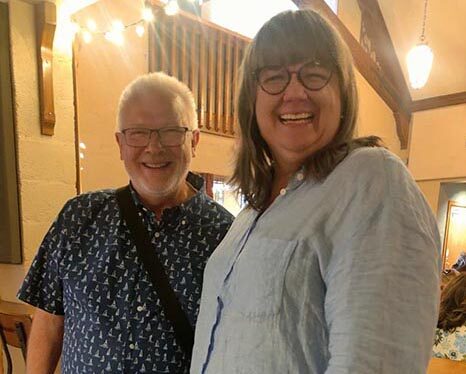
Rodney hails from Launceston, Tanzania; the Churchill Fellowship that he received offers Australian citizens and permanent residents the opportunity to travel overseas to research a topic of benefit to Australia and the fellow’s community. Recipients commit to sharing knowledge or skills upon their return, which Rodney will do through his work with the LIFE Food Hub and, given his nature, well beyond.
The Food Club Network and each of the three member organizations were honored to host Rodney in May to exchange perspectives, approaches, and knowledge. Midway, Rodney took time to answer some questions about his global research.
How did you come to take on this research project?
My long-term background is in executive management in a more commercial environment, but when I retired from those roles, I wanted my last working years to be in community. It’s always been my passion. So I moved to become CEO of a local welfare organization in Launceston, the Launceston Benevolent Society. They were predominantly a food relief organization, but provided other services as well to support people in the community.
Being a small to medium sort of charity, I had very much hands-on experience. It was a fantastic learning experience for me because I was close to the people that we were supporting. I made a choice to work closely with the homeless community, too, visiting their camps and going around and talking to them to understand their problem and to better understand the area and the work that we were doing. I moved on from there to actually coordinate a number of homeless services for St. Vincent de Paul Society.
I coordinated food vans, soup vans, and also introduced a community hub for the homeless around breakfast service, laundry, showers, and support. Emotional support as much as anything, a place for them to feel welcome and to have a normal conversation with volunteers. Everything I do, I like to provide dignity in the process.
And that’s really led me to the project I am on now. I decided to pursue the food security area because I could see issues with the way we were providing food relief in Australia—it’s similar to everywhere I’ve gone so far. Traditionally, it was very transactional in either, we were providing hampers where people had no selection, or we were providing food pantries where people had limited selection, often with volunteer oversight. So it wasn’t real choice. And there was a very selective process that went into people being able to access those services, which often felt a little undignified. A number of people who needed support wouldn’t access it because of the stigma involved. So I’d been thinking about how we could do this better for some time and the concept of a social supermarket was entering my mind with some research I was doing.
And at the time I was working with one of those organizations and I felt that they were not going to be able to pivot to a new model. It was too difficult for those existing organizations; although they talked about a hand up, it was very difficult for them to provide it because they were so wound up in just the immediate needs of people. It is so very hard for those bigger organizations to pivot.
I knew, or I thought, that to be able to do this successfully and to do it quickly, or as quickly as I could, was to start a new organization. So I started the launch as an independent food enterprise, which is LIFE for short.
I was lucky enough—about a thousand people apply for those hundred [Churchill Fellow] opportunities—to go through the process to receive this opportunity. The information I’ll receive from this trip will not only inform my project on the ground, but there’s a lot of interest throughout Australia. We’re very much in the infancy of moving in this direction, but there is a lot of momentum. We have a number of people within my network right across Australia who are very interested in seeing the outcomes from this tour.
What have you seen or heard thus far in your Food Club Network visits?
There are differences in the history and how we’ve all got to where we are systemically and culturally, but when it comes down to it, we’re all dealing with the same problems and the same issues regardless of how we’ve got to that point. We’re all seeing a growth in demand and I think that’s been heightened from COVID and from decisions both our governments make. And we’re seeing the cost of living, particularly in Australia, going up at a rate that is outstripping wage growth and certainly welfare growth, because welfare growth goes at a much slower pace than inflation.
So that gap is widening, and there are more people starting to fall into that area of need and a lot of people who haven’t traditionally accessed food relief. And I think that’s the same here: you are seeing a lot more people who haven’t accessed services before, who may be working but are relatively low income, and are still struggling because of the cost of housing, the cost of interest rates, the cost of rent.
And we’re seeing exactly that in Australia as well. So the issues are no different. You’re slightly more advanced in addressing it through the social supermarket model or the community food club model. We’re in our infancy in doing that in Australia. We’re just seeing now that that’s possibly a more resilient way to move forward. I believe what we are doing is creating a sense of reliance, whereas we need to move to supporting people to become a bit more resilient and self-supporting and empower them to do so. And I think the food clubs are the right model in doing that.
For me, and it’s the same for everyone I’m meeting through the Food Club Network, dignity sits at the top of the pyramid in all of this in why we’re doing what we’re doing and that’s exactly why we’re doing in Tasmania what we’re doing. It’s all about respecting people’s dignity; that’s the area we can do a lot better and you’ve started to do it a lot better. And along with that becomes choice, because choice is part of dignity, and also a better focus on nutrition. And I love the way that the point systems work here where the points are lower for healthier options like your fresh produce. That’s encouraging people to use their points on their fresh produce. It’s important that we encourage better eating because the basis of our good health is what we eat.
But what I am learning here too is food procurement, where you’re getting your food from, the networks that are involved there, the work that has to go into procuring that food, and of course the funding, which were all areas that I was interested to see. I’m really interested in sustainability and how these models can be sustained without total reliance on government, because government policy changes, as it is here in America, often not in the right direction for people who need support. We can’t entirely put all our eggs into the government basket. Seeing how that works and how you work with local farmers and with distribution groups—all this is valuable information that we can learn from.
Your emphasis on dignity is certainly a shared value with the Food Club Network.
That’s come from my own values, to be honest. My values are not religious values; they’re human values. I think that’s been, for me, working on the ground, at all levels, really, getting to know people who are in these complex situations in their own lives and just seeing how a little bit of respect to them and a little bit of dignity in the way we provide support can mean so much more. Running the homeless service that I did, the most important aspect, although there were things that were important, providing them breakfast, a place to launder their clothes and have a shower, the most important thing was providing a space for them to feel welcome and comfortable for three hours a day where they could just sit, do what they needed to do, but also have a normal conversation and feel like a normal human being.
That was the most important aspect of that service and that stayed with me. Whatever we do, we’ve got to do it in a dignified way so people can feel like a human and not like someone who is being left behind by society or feels wasted by society.
The food club and Food Club Network executive directors were energized by and learned from their conversations with Rodney.
“Rod may be the first person to undertake an international survey of what he calls ‘social supermarkets,’” notes Lura Barber, executive director of the Food Club Network. “His work couldn’t be more timely or necessary. As I follow his journey, I’m reminded that we are not alone and I draw strength from the example of others who are doing this work around the globe.”


