
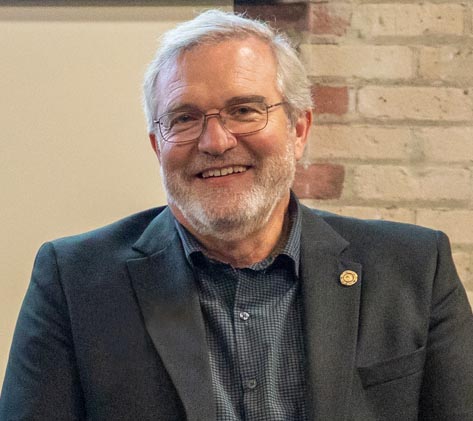
When Ken Estelle retired as President and CEO of Feeding America West Michigan this month, he closed a remarkable chapter in hunger-relief work that spans far beyond any one organization.
Ken joined Feeding America West Michigan in 2011 after leaving a successful 30-year career in aerospace and defense. But his connection to hunger relief began long before that. As a volunteer at a mobile food pantry, he came face-to-face with neighbors experiencing food insecurity and realized how easily life’s circumstances can change for any of us.
That experience stayed with him and ultimately led him to a new calling: helping ensure that everyone has access to nourishing food and is treated with dignity along the way.
Over the next 15 years, Ken guided Feeding America West Michigan through significant growth, expanding food distribution across a 40-county service area, helping navigate the challenges of the COVID-19 pandemic, and serving as a respected voice within both the Feeding America network and the Food Bank Council of Michigan. Yet some of his most lasting contributions are found not only in pounds distributed and warehouses expanded, but in the partnerships he helped build.
One of those partnerships helped shape what is now known as the food club model.
Early in his tenure, Ken joined a group of community leaders who were exploring a different approach to food assistance—one that would move beyond traditional pantry models and create a more dignified, grocery store-like experience. At the time, there were few examples to follow. Together, the group designed a model centered on choice, ownership, and respect for the people it served. That work eventually became the Community Food Club in Grand Rapids.
According to fellow founding member Dave Jacobs, Ken’s involvement was pivotal. His experience, connections, and practical understanding of operations helped move the concept from vision to reality. More importantly, he brought a collaborative spirit that helped keep partners aligned around a common goal.
Years later, Ken would describe the Community Food Club as one of the most impactful collaborations of his career, noting that it began when local nonprofit leaders came together and simply said, “Let’s do something different.”
Today, that spirit continues to influence food clubs and community-based food systems across Michigan and beyond.
For those connected to The Food Club Network, Ken’s legacy is visible in every effort to create food access that is rooted in dignity, choice, and community. His work helped demonstrate that addressing hunger is not only about providing food. It is also about building systems that respect people and strengthen communities.
As Ken steps into retirement, we celebrate not only his years of leadership, but also the values that shaped that leadership: service, humility, innovation, and collaboration.
The food club movement is stronger because of his contributions, and countless individuals, families, and communities are better served because he chose to answer a calling that began many years ago at a mobile pantry.
Thank you, Ken, for helping imagine something different—and for helping make it possible.